
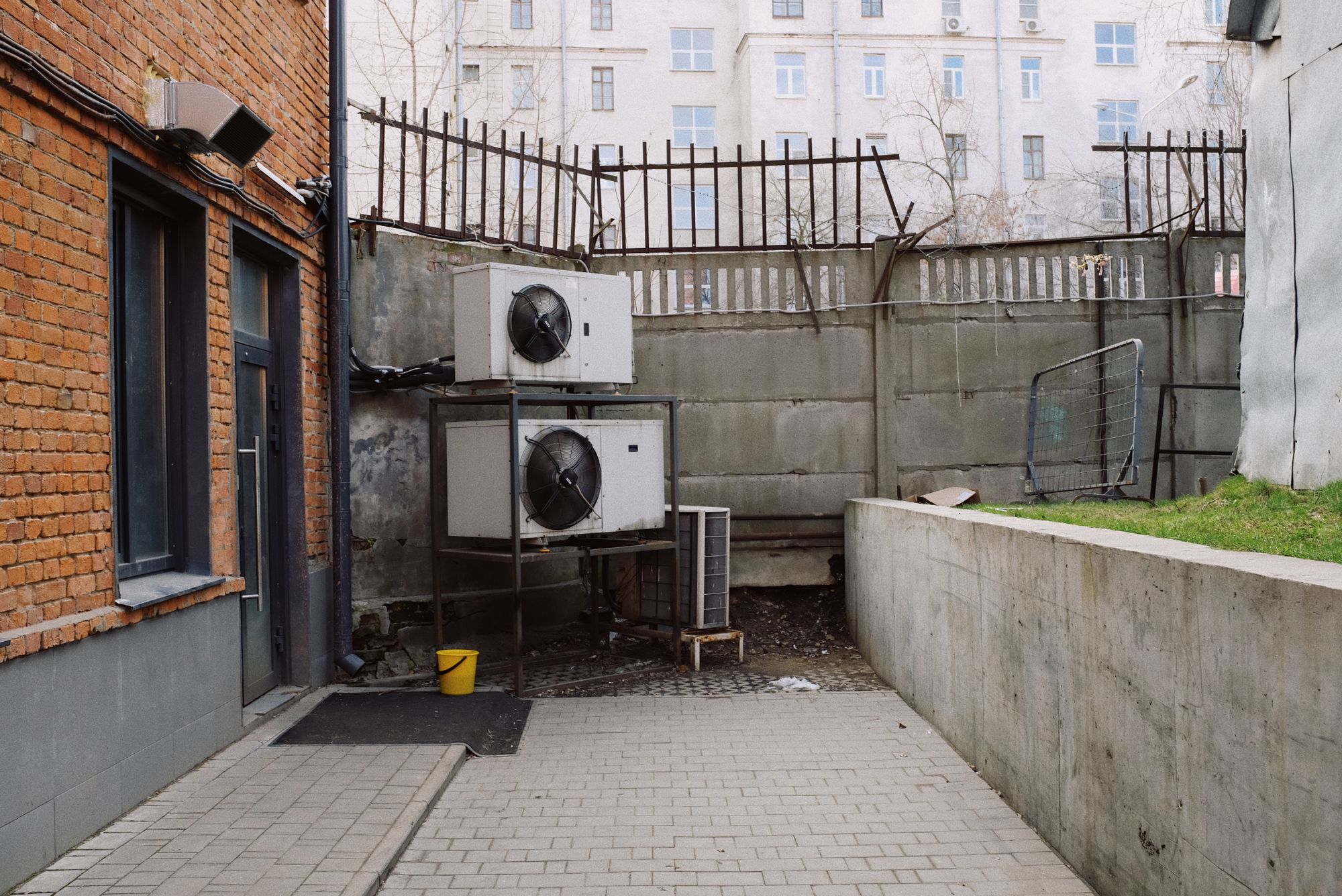
If you've got air conditioning, a heat pump or commercial refrigeration on your site, you're already in scope of the UK F-Gas Regulation — whether you realise it or not. F-Gas isn't a label you can ignore until something breaks. It's a continuous duty on the owner or operator of the equipment, with leak-check intervals, record-keeping requirements, and real enforcement teeth from the Environment Agency. This is the plain-English version for landlords, building managers, facilities teams and small-business owners across the UK.
What F-Gas actually is
F-Gas is short for fluorinated greenhouse gases — principally hydrofluorocarbons (HFCs) such as R410A, R32, R134a, R407C, R454B and others. These are the refrigerants that circulate inside air conditioners, heat pumps, commercial fridges and chillers, doing the actual job of moving heat. They have global warming potentials (GWPs) hundreds to thousands of times higher than CO⊂2, so when they leak they matter.
The UK retained the EU F-Gas Regulation post-Brexit and has been amending it through DEFRA. The 2024–2026 phase-down has steadily reduced quotas for high-GWP refrigerants, which is why R410A systems have been giving way to R32 in residential AC and heat pumps.
Who is the “operator”?
In F-Gas law, the operator is the person or business with actual control over the technical functioning of the equipment. In practice, that means:
- The owner of the equipment, unless they've contracted control away.
- A tenant if they have full operational control and the contract says so.
- The landlord for commercial leases where the AC is part of the building services and not the tenant's responsibility.
- A managing agent can act on the operator's behalf, but the underlying duty stays with the legal operator.
Ambiguity here is common. We strongly recommend that lease agreements explicitly state who is the F-Gas operator for any cooling or heat pump equipment in the building.
Operator duties at a glance
- Use only certified contractors. Any F-Gas work — install, service, leak check, decommission, refrigerant recovery — must be done by an F-Gas qualified engineer working for an F-Gas certified company.
- Carry out leak checks at the intervals required by the system's CO⊂2e charge.
- Keep records for at least 5 years — quantities and types of refrigerant added or recovered, leak check dates, engineer details.
- Fix leaks promptly and re-check 1 month later.
- Properly decommission equipment at end of life with refrigerant recovered, not vented.
- Install automatic leak detection for larger systems (500+ tonnes CO⊂2e).
Leak check intervals — the table
The intervals are based on CO⊂2e (CO⊂2 equivalent) charge, which equals refrigerant kg multiplied by GWP. Your installer should label every system with its CO⊂2e charge.
- Less than 5 tonnes CO⊂2e: No mandatory checks (but hermetically sealed systems have a special < 10 tonnes threshold).
- 5 to less than 50 tonnes CO⊂2e: Leak check at least every 12 months.
- 50 to less than 500 tonnes CO⊂2e: Leak check at least every 6 months.
- 500 tonnes CO⊂2e or more: Leak check at least every 3 months, plus automatic leak detection required.
- If automatic leak detection is fitted, intervals can usually be doubled.
A typical commercial VRF with around 15 kg of R410A has a CO⊂2e charge of roughly 31 tonnes — squarely in the annual leak check bracket.
What is REFCOM?
REFCOM is the UK's main F-Gas company certification body, operated by the Building Engineering Services Association (BESA). Their two main certificates are:
- REFCOM F-Gas — the legal minimum for any UK company handling F-Gases on stationary systems.
- REFCOM Elite — an enhanced scheme with additional auditing covering quality, safety and environmental management.
As an operator, you are required to use a certified company — not just a qualified engineer. Always ask for the company's REFCOM number. It's verifiable on the public register.
What enforcement looks like
F-Gas is enforced in England by the Environment Agency (Natural Resources Wales in Wales, SEPA in Scotland, NIEA in Northern Ireland). Civil penalties are tiered, with maximums reaching £200,000 for the most serious offences such as deliberately venting refrigerant. More routine non-compliance attracts fines from a few hundred pounds upwards, often combined with corrective action notices.
The most common compliance failures we see when surveying buildings:
- No record of leak checks ever being carried out.
- Service company couldn't produce REFCOM certification.
- System never labelled with refrigerant type or CO⊂2e charge.
- Refrigerant top-up done without identifying and fixing the underlying leak.
- Decommissioned units left on roofs with refrigerant still in them.
Landlord-specific notes
If you let a residential or commercial property that has air conditioning or a heat pump installed:
- Clarify in the lease whether the F-Gas duty sits with you or the tenant.
- If you retain operator duty, schedule the leak checks and keep records yourself.
- If duty passes to the tenant, make sure the lease requires them to use certified contractors and supply you with records on request.
- End-of-tenancy: don't allow installed AC to be removed by uncertified handymen. We've recovered refrigerant from skips more than once.
The phase-down: what new installs look like
The UK F-Gas phase-down is driving installers toward lower-GWP refrigerants. In 2026 this mainly means:
- R32 (GWP ~675) in domestic and small commercial AC and heat pumps — now the dominant refrigerant for new splits and small VRF.
- R454B / R452B (GWP ~466) in mid-size commercial and chillers.
- R290 (propane) in monobloc heat pumps and some commercial refrigeration — very low GWP but flammable, so handled with appropriate safety classification.
- Old R410A and R407C systems continue to be serviced, but quota restrictions are pushing recycled refrigerant prices up.
FAQ
Who needs an F-Gas certificate in the UK?
Any person or company that installs, services, maintains, repairs, decommissions or leak-checks stationary refrigeration, air conditioning or heat pump equipment containing fluorinated greenhouse gases must hold a valid F-Gas qualification, and the business must be certified as a Company (typically via REFCOM).
What is REFCOM?
REFCOM is the UK's main F-Gas company certification body. A REFCOM Elite or REFCOM F-Gas certificate confirms a business meets the legal requirements to handle F-Gas refrigerants. Operators are legally required to use a certified company.
How often must F-Gas leak checks be carried out?
Frequency is based on the CO⊂2e charge of the system. 5–50t = annual, 50–500t = 6-monthly, 500t+ = quarterly. Automatic leak detection generally doubles the allowed interval.
Are landlords responsible for F-Gas compliance?
Usually, yes. The “operator” — the party with actual control over the equipment — carries the duty. For commercial leases this is often the landlord; for full-repairing leases it can pass to the tenant. The lease wording decides.
Will F-Gas refrigerants be banned?
Not banned outright, but phased down. UK F-Gas regulation steadily reduces the quota of high-GWP refrigerants like R410A. New installs are moving to lower-GWP alternatives such as R32, R454B and natural refrigerants. Existing systems can continue to be serviced.
Need an F-Gas registered company for service, leak checks or PPM in Kent and South East London? We're REFCOM certified and run logbooks for landlords, offices and multi-site clients. See our service & maintenance capabilities or request a quote for a compliance review.